


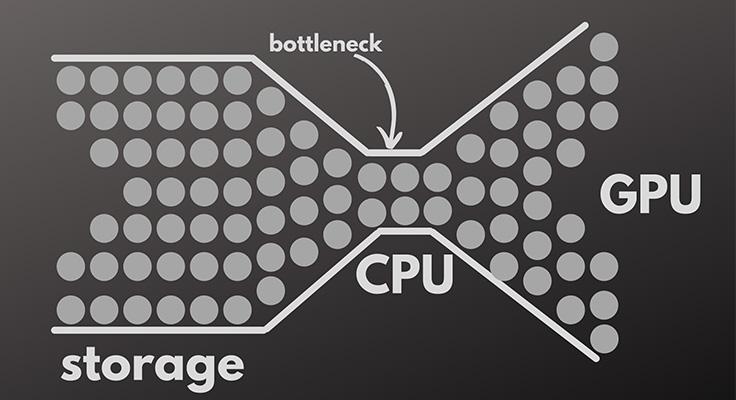
Modern computers rely on a delicate balance of components to perform at their best. Among these, the CPU (Central Processing Unit) and GPU (Graphics Processing Unit) play the most critical roles in determining how smoothly applications, particularly games and heavy software, will run. When these components are not balanced properly, a situation called a bottleneck arises.
This article explores what CPU bottleneck and CPU-GPU bottleneck mean, why they happen, how to identify them, and ways to reduce their impact for a smoother computing experience.
What is a Bottleneck in a Computer System?
In computing, a CPU bottleneck refers to a situation where one component of the system limits the performance of the entire machine. Just like a narrow neck of a bottle restricts liquid flow, a slower or weaker part of your computer holds back other, faster parts.
For example, imagine you have a very powerful graphics card but a weak processor. The GPU may be capable of rendering frames quickly, but if the CPU cannot provide data at the same rate, performance suffers. This imbalance between components is what we call a bottleneck.
CPU Bottleneck Explained
A CPU bottleneck occurs when the processor becomes the limiting factor in a system’s performance. Even though other components like the GPU, RAM, or SSDs may be ready to perform at their full potential, the CPU cannot keep up, resulting in lower performance.
Common Causes of CPU Bottleneck
-
Weak or outdated processor – Older CPUs struggle to handle modern workloads.
-
High background processes – Excessive software running in the background eats into CPU capacity.
-
Incompatible hardware pairing – Using a very high-end GPU with a low-end CPU often causes bottlenecks.
-
Single-thread limitations – Some games and applications rely heavily on single-core performance, which can overwhelm a weaker CPU.
Symptoms of CPU Bottleneck
-
High CPU usage (90–100%) while GPU usage remains low.
-
Stuttering or lag in games despite having a powerful graphics card.
-
Lower than expected frame rates.
-
Longer load times in CPU-heavy applications such as video editing or 3D modeling.
What is a CPU-GPU Bottleneck?
A CPU-GPU bottleneck is a more specific type of bottleneck where the mismatch occurs directly between the processor and the graphics card. In simple terms, one of them is too powerful compared to the other.
-
CPU bottleneck in a CPU-GPU setup: When the CPU is too weak for the GPU, the graphics card cannot reach its maximum potential because it waits for instructions from the processor.
-
GPU bottleneck in a CPU-GPU setup: When the GPU is too weak compared to the CPU, the processor can handle more tasks than the graphics card is capable of processing, leading to underutilization of CPU power.
Example Scenarios
-
Pairing an RTX 4090 GPU with an entry-level CPU like Intel i3 can cause a severe CPU bottleneck in games.
-
On the other hand, pairing a powerful CPU like Ryzen 9 7950X with a mid-range GPU like GTX 1650 would result in a GPU bottleneck.
How to Identify a CPU Bottleneck
Before upgrading or replacing hardware, it is important to confirm whether you are facing a bottleneck. Here are ways to identify it:
1. Monitoring CPU and GPU Usage
-
Use tools like MSI Afterburner, HWMonitor, or Task Manager.
-
If CPU usage is consistently near 100% while GPU usage stays low, a CPU bottleneck is likely.
2. FPS Drops and Stutters
-
Sudden FPS drops or stutters in games even with a high-end GPU suggest CPU limitations.
3. Game Type Analysis
-
Games that require heavy AI calculations, physics simulations, or large multiplayer environments (e.g., strategy games or MMOs) usually stress the CPU more.
How to Fix or Reduce CPU Bottleneck
A CPU bottleneck doesn’t always mean you need to buy a new processor immediately. There are several ways to reduce its impact:
1. Lower CPU-Intensive Settings
-
Reduce settings like draw distance, shadows, reflections, or crowd density in games.
-
These rely more on the CPU than the GPU.
2. Close Background Applications
-
Shut down unnecessary apps such as browsers, updaters, and launchers before running games.
3. Enable Multithreading or SMT
-
Many modern CPUs support Hyper-Threading (Intel) or Simultaneous Multithreading (AMD). Enabling these can boost performance in multi-threaded applications.
4. Overclock the CPU
-
Slightly increasing the CPU clock speed can reduce bottlenecks if done safely with proper cooling.
5. Upgrade Hardware
-
If the CPU is outdated, upgrading to a modern processor with more cores and threads may be the only long-term solution.
How to Avoid CPU-GPU Bottleneck When Building a PC
When building or upgrading a system, balance is key. Here are some tips:
1. Match CPU and GPU Power Levels
-
Pair mid-range GPUs with mid-range CPUs.
-
High-end GPUs require equally powerful processors.
2. Check Bottleneck Calculators
-
Online tools like bottleneck calculators give estimates of component balance.
-
While not 100% accurate, they provide a good starting point.
3. Future-Proofing
-
If budget allows, choose a slightly stronger CPU. Graphics card technology evolves quickly, and a better CPU ensures you won’t face bottlenecks with future GPU upgrades.
4. Consider Resolution and Frame Rate Goals
-
Higher resolutions like 1440p or 4K rely more on the GPU than the CPU.
-
Lower resolutions like 1080p can reveal CPU bottlenecks more clearly.
CPU Bottleneck vs GPU Bottleneck
It’s important to distinguish between the two:
| Feature | CPU Bottleneck | GPU Bottleneck |
| Cause | CPU is weaker than GPU | GPU is weaker than CPU |
| Symptoms | High CPU usage, low GPU usage, stutters | High GPU usage, smooth CPU performance |
| Common in | High FPS, low-resolution gaming | High-resolution, GPU-heavy games |
| Solution | Lower CPU-intensive settings, upgrade CPU | Lower graphics settings, upgrade GPU |
Both types of bottlenecks can affect gameplay, but CPU bottlenecks are often more frustrating because they cause stutters and inconsistent frame pacing, while GPU bottlenecks usually just lower the overall FPS.
Real-World Examples
-
CPU Bottleneck Example
-
A gamer pairs an NVIDIA RTX 3080 with an older Intel i5-7400 CPU. In modern AAA games, the GPU has more rendering power than the CPU can supply instructions for, causing the GPU to run at only 50–60% usage.
GPU Bottleneck Example
-
A workstation with a Ryzen 9 5900X CPU and a budget GTX 1050 Ti GPU. Here, the CPU easily handles complex tasks, but the GPU cannot deliver high frame rates, creating a GPU bottleneck.
Should You Worry About Bottlenecks?
Every system has some degree of bottleneck. The goal is not to completely eliminate it but to reduce it to a level where performance remains stable and satisfactory.
-
If your CPU bottleneck reduces performance by 5–10%, it’s usually acceptable.
-
A bottleneck causing 30–40% loss, however, indicates a serious mismatch in hardware that should be addressed.
Conclusion
CPU bottleneck and CPU-GPU bottleneck are common performance issues that arise when system components are unbalanced. While a CPU bottleneck occurs when the processor is too weak to keep up with other parts, a CPU-GPU bottleneck specifically highlights the imbalance between the CPU and the graphics card.

 Arabic
 French
 Spanish
 Portuguese
 Deutsch
 Turkish
 Dutch
Dutch
 Italiano
 Russian
 Romaian
 Portuguese (Brazil)
 Tiếng Việt